|
In memory of those who have Crossed the Bar
Ships served in:
Guelph man
survived kamikaze attack during Second World War
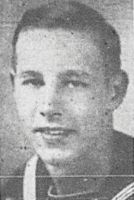
Able Seaman Frederick Mitchell of Guelph Photo from Guelph Mercury
GUELPH - Able Seaman Frederick Mitchell of Guelph had the distinction of serving aboard a Canadian naval vessel that saw action against the Japanese during the Second World War, and as such was the only Guelphite known to experience a kamikaze attack. Later, he was also part of the crew involved in the controversial “Uganda Episode.”
Born in England in 1923, Mitchell was the adopted son of Henry and Rose (nee Mitchell) Tims of Exhibition Street. Records show Fred was actually Rose’s nephew. He was an employee of Guelph’s Callander Foundry when he joined the Royal Canadian Navy (RCN) in January, 1944.
Mitchell was eventually assigned to HMCS Uganda, a heavily-armed, light cruiser originally constructed for the Royal Navy but transferred to the RCN in October of 1944. The Uganda had seen action in the Atlantic, the Mediterranean and the Pacific. At the time Mitchell reported for duty, the Uganda had a crew of 907 officers and ratings from across Canada under the command of Captain Edmond Mainguy of Victoria, BC. Even though she was officially a Canadian warship, the Uganda was attached to the Fourth Cruiser Squadron of the British Pacific Fleet, joining it at Sydney, Australia.
In April, 1945, as a member of the Royal Navy’s Task Force 57, the Uganda took part in attacks on Japanese airfields and other military installations on the island of Formosa (now Taiwan). She then participated in the bombardment of Japanese airbases on the Sakishima Islands. By this stage of the war, the Japanese, having suffered huge losses at sea and in the air, had been forced to withdraw from many of the Pacific islands they had occupied, and were now faced with the prospect of defending their homeland from an Allied invasion.
In a desperate campaign to drive off the enemy, Japanese suicide pilots called kamikaze (divine wind) attempted to crash planes loaded with explosives into Allied ships. For the men aboard a targeted ship, the only defence against a kamikaze plane was for the anti-aircraft gunners to shoot it down before it could hit their vessel.
In one terrifying episode, wave after wave of kamikaze planes attacked the British fleet. Five RN aircraft carriers; Formidable, Victorious, Indomitable, Illustrious and Indefatigable were hit and suffered damage and casualties, but were not sunk. The Uganda was in the thick of the fight, for which she would receive battle honours. Her gun crews sent hundreds of rounds of long and short-range ammunition at the attackers. Mitchell was stationed in the “director,” an installation that was part of the gunners’ targeting system. He wrote about it in a letter home.
“The Japanese are desperate men. They send up suicide bombers, which head for the bridge or director, which I am in. Oh boy! Some excitement, Mom, no kidding!”
Mitchell also wrote about other aspects of life at sea and his visits to Australian ports.
“I have been scrubbing and polishing and painting on the bridge. If you want to see brass, you should see this. There is no end to the stuff. I will admit, however, that it looks a picture, when it is polished and cleaned up.
“Wherever we went the Australian people were ever so grand to us. They don’t see any Canadian sailors in Australia, so they were ever so pleased to have us there … In Freemantle they supplied the ship with ditty bags for all personnel on board the ship. They also filled the ship up with fruit, and we had fruit every day for about a month … In Sydney we paraded for a victory loan parade … It was a grand sight, and we were well cheered by the Australians.”
Mitchell’s letter, which was quoted in an article in the Mercury, was dated May 1, 1945. One week later, a very unusual vote took place on the Uganda. The story behind it had begun back in 1940 when the Liberal government of William Lyon Mackenzie King won re-election on a platform that included a promise not to impose military conscription. In late 1944, facing manpower shortages in the armed forces, King had reneged and allowed conscription. Now he was looking at an election in 1945 with the opposition accusing him of breaking an election promise. To try to deflect that political attack, and with the war in Europe over, King said only volunteers would be required to fight against Japan.
The crew of the Uganda – volunteers to a man – were already fighting the Japanese and were now being asked if they wanted to volunteer again. It seemed ridiculous to them. There was already considerable discontent among the ratings. The Uganda had not been allowed to fly Canada’s Red Ensign or have a maple leaf painted on the funnel identifying her as a Canadian ship. Many of the crew felt slighted by that.
Living conditions on board were poor. Drinking water was in short supply, the food was bad, and the ship was infested with rats and cockroaches. The ventilation system wasn’t working very well; the temperature in the boiler room hit 115 degrees Fahrenheit (46 C). To make matters worse, almost everyone aboard was suffering from athlete’s foot. As one sailor put it later:
“Maybe we were going a bit wonky … But a lot of the guys were married. They’d been away from home for four or five years. Everyone already felt like they’d been through hell – and all of a sudden you’re given a chance to get out? Well, holy jeez, life’s got to be better than this.”
Then Captain Mainguy made a speech that just rubbed everyone the wrong way. The result was that nearly two-thirds of the crew did not vote to re-volunteer. The ship would have to sail to Canada to replace those crewmembers with volunteers.
As it turned out, the Uganda was sidelined anyway by a broken boiler. By the time she docked in Esquimalt, BC, the war with Japan was over. We don’t know which way Fred Mitchell voted in the Uganda Episode. Unfortunately – and unfairly considering her excellent record – the Uganda’s reputation was tarnished. She was known as the only ship to vote herself out of the war.
|